 The
general goal of the project was to preserve wildlife, improve
natural habitats and their management in the North-Western part
of the Black Sea Region. The
general goal of the project was to preserve wildlife, improve
natural habitats and their management in the North-Western part
of the Black Sea Region.
Objectives:
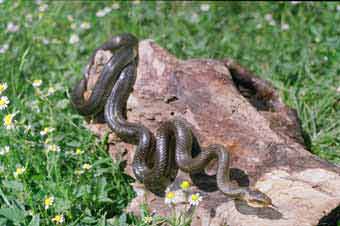
1) To save endangered species of snakes associated with
steppe and forest-steppe habitats;
2) To improve baseline knowledge about rare fauna and flora within
the Lower Dniester Ramsar Site territory;
3) To create conditions for restoring the critical steppe habitats.
Moldova is predominantly agricultural country with a high density
of rural population; protected areas occupy 1.96% of territory only.
Steppe-related habitats natively prevalent became the less conserved
and seriously suffered from grazing. in the Lower Dniester Ramsar
Sitea no. 1316, natural and subnatural areas in its hilly part are
represented by 6 steppe-related biotops that are modified in diverse
degree and require serious improvements, which would encourage ecological
value with respect to threatened snakes, insects and other species,
and carrying capacity for livestock. Project improved knowledge
on local population of European-concern snakes and other species
of Moldovan and Ukrainian Red Data Books, vegetation of steppe pastures;
provide appropriate management planning based on these data; raised
awareness of local people on steppe biodiversity values and created
pilot nurseries in order to increase local resources for steppe
restoration using method of agro-steppe. The method was elaborated
in Russia while Moldova had no experience in steppe restoration
till now despite the fact that about 12% of territory is under predominantly
steppe grazing lands that became centers of desertification and
biodiversity loss.
The
crucial necessity of restoration of the steppe communities is evident
from the both conservational and economic standpoints. Fragmentation
and small areas of the better-preserved natural habitats strongly
impedes spreading of plants and animals, especially snakes (which
are not so mobile), as well as self-restoration processes in subnatural
habitats of local communities. Lack of corridors interconnecting
the natural and subnatural areas limits possible increase of biodiversity
in subnatural lands. That means the physical establishment of ecological
network is of priorities. The local biodiversity improvements are
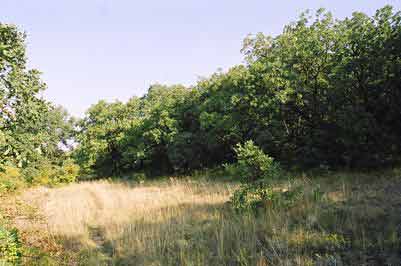
easier in fragments of the territory where is native type of vegetation
comprising stands of the Pubescent Oak and steppe glades. Created
steppe seed nurseries should be extended to increase source of steppe
restoration. The crucial condition for practical restoration of
steppes used for grazing is return to crop rotation in arable lands
and installation of livestock-breeding farms that would allow relieving
the pastures of excessive grazing.
The project field team had investigated the target area during 6
common expeditions. Field findings were databased and mapped. Analysis
of distribution of threatened species and valuable habitats fulfilled,
results mapped and generalized. Testing of state in endangered snakes
populations based on distribution and age composition was carried
for the first time in Moldova and brought important results from
the viewpoint of their conservation.
Many trips were done to organize collecting of seed materials and
prepare the creating steppe seed nurseries. Multifunctional Reserve
“Steppe sector on the North of Budjac”
was determined as the most appropriate source of seeds considering
location (South of Moldova), high species richness and possibility
to operate with different types of plant associations with various
ediphicators. A permission to use the Reserve was taken from the
Ministry of Environment and Natural Resources and
co-agreed with authorities of Gagausian Autonomy and the local community.
Quantity of the feather-grass seeds was increased essentially by
those collected on local places; additionally experts gathered seeds
of early flowering Stipa pulcherrima in a site of Transdniestria.
Thus, quite rich and diverse pool of seed material was obtained,
prepared and put for storage. Soil preparation and sowing were organized
in cooperation with local authorities, who were provided with recommendations
on how to manage by concrete seed nursery in each community, and
school children were involved to do main sowing work and to plant
a hedgerow from purchased seedlings. Seeds reserves of two hectares
each were created in three localities on the basis of agreements
between juridical persons that fulfilled civil works for soil preparation
and sowing, BIOTICA ES that provided technology,
seed material and financing at the expense of grant (agreements
notice financing from source of the Frankfurt Zoological Society),
and local authorities that provided land allotment and engaged oneself
to take care and manage seed nurseries in accordance with recommendations
provided by BIOTICA ES. Project experts introduced
five threatened and relict ephemeroid species in seed nurseries
manually and provided sowing of Pubescent Oak, Royal Purple and
Barberry (typical steppe shrub) along border of seed parcel situated
in the main area of E. quatuorlineata distribution. That was done
in order to hide nearest artificial planting and improve landscape
in future, and also to design the edge of typical forest-steppe
place. Planting of hedgerow around this parcel finished this work.
After researching the territory, specialists elaborated a Management
Plan addressing to local authorities and the Ministry of
Ecology and Natural Resources (full
version in Russian) for the managing of steppe ecosystems.
It includes three parts.
Part I is the General description of territory
that comprises sections: General Description of Steppe Communities
(Types of steppe communities with Brief on state of steppe Communities,
Special value of territory); Key Natural Complexes (core areas);
Bearing Areas of Ecological Network (sectors of ecological restoration);
and Single Complexes Perspective for Ecological Restoration.
Part II is Evaluation and General Conclusions
that comprises sections: Importance of Territory; Perspective Managerial
Objectives; Major Threats and Managerial Issues (Recent processes
and dangers including Processes of loss of biodiversity and resource
importance of steppe ecosystems, Foreseen natural factors and connected
the beginning processes, Lacks in management of natural resources
and linked degradation factors; Main Managerial Issues); and Management
Constraints
Part III is Managerial Measures for Areas
Supporting the Steppe Ecosystems with sections: Present-day
goals and tasks; Managerial Measures including Suggestions to create
Protected Zones of the District Importance*; and Suggestions on
Ecological Reconstruction of areas of the territory and support
of protected species and valuable communities.
Annexes to the Management Plan include Recommendation
on the radical improvement of forage grounds (there
are two sections: Radical pasture improvement with sowing of mixture
of herb cultivars; Steppe forage grounds – agro-steppes), Recommendations
on surface improvement of forage grounds, Recommendations on enriching
the steppe glades, forest edges and open steppe sectors.
Also popular brochure “Steppes
of Lower Dniester: richness and poverty” was prepared
and edited in Romanian and Russian versions that comprises useful
information regarding the history and actual state of the territories
with steppe ecosystems, the methods of their improving. This broshure
is for everybody who is interested in conservation of the natural
inheritance.
|


